
A sales head decides the team needs a CRM. The licences are bought, the reps are trained for a day, and for a few weeks the data comes in. A year later the reports still go out on WhatsApp, and the CRM holds a customer list nobody trusts.
This happens often enough that it is worth asking a few questions before you sign anything. None of them are about features. They are about whether the system fits the way your people work.
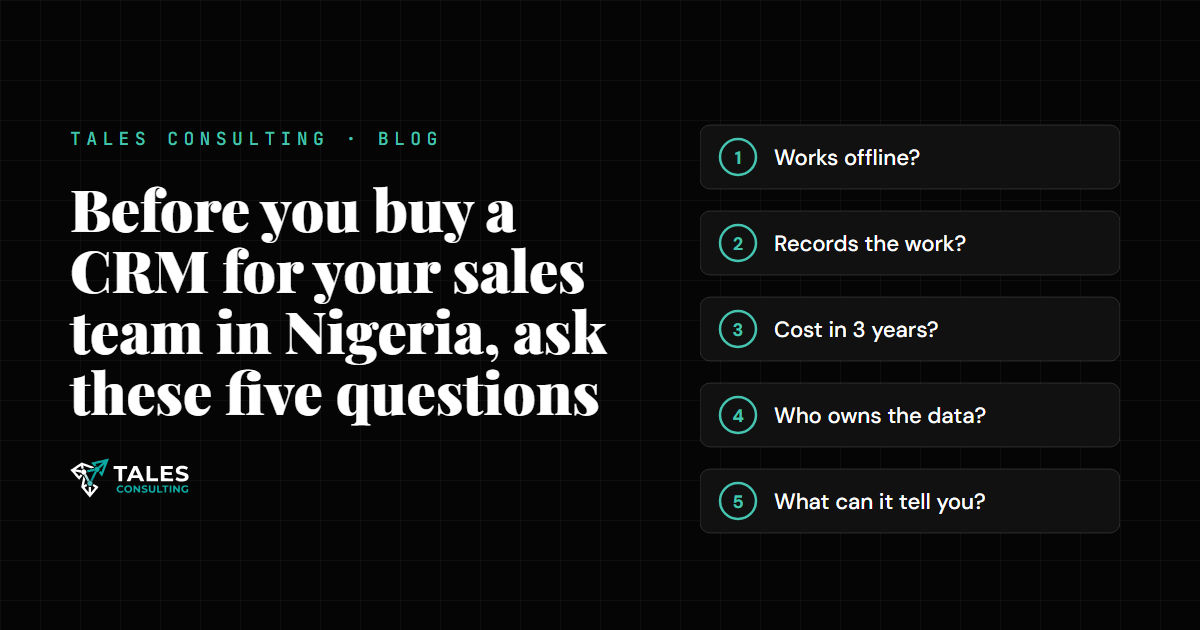
1. Will it work where your reps work?
Most CRMs are built for people at a desk with steady internet. Your reps are on the road, in markets and in pharmacies, often with weak or no signal. If the app needs a connection to save a visit, the visit will be recorded later from memory, or not at all.
Ask whether the app works fully offline and syncs when the signal comes back, and test it on a real route before you buy.
2. Does it record the work, or ask for a report about it?
A system that depends on reps filling in forms at the end of the day will get short, late and tidied-up entries. The useful detail is in what happened during the visit: when they arrived, how long they stayed, what was ordered, what the outlet owner said, what was on the shelf.
Ask how much of that is captured as part of doing the job, and how much depends on typing afterwards.
3. What will it cost in naira in three years?
Many CRMs are priced per user per month in dollars. That looks manageable for ten users. For eighty reps, with the exchange rate moving, it becomes one of the larger lines in the sales budget, and you pay it every month for as long as you use the system.
Work out the three-year cost at today's rate and at a worse one. Then compare it with owning a system outright.
4. Who owns the data, and can you get it out?
Your customer list, visit history and order records are some of the most valuable things your sales team produces. Ask where they are stored, who can see them, and what format you get them in if you leave. If the answer is vague, assume leaving will be expensive.
5. What can it tell you, beyond what you typed in?
A CRM is very good at storing contacts and showing you a pipeline. It is rarely built to tell you why one rep outsells another, which customers are about to stop ordering, or which discounts are costing more than they bring back.
Ask what questions the system can answer about your business that you could not answer from a spreadsheet. If the answer is "reports", you are buying a better spreadsheet.
The alternative
For some teams an off-the-shelf CRM is the right choice, and if it passes these five questions it may be. For field teams in Nigeria it often does not, which is why we build field sales software for one company at a time: offline-first, owned by the company, with no per-seat licence in dollars, and with an AI that reads the record and answers questions about the team.
If you are weighing up a CRM now, bring us your shortlist and we will go through these questions with you.