
Ask most sales heads who their best rep is and they will name the person at the top of last month's sales report. That person may well be good. They may also have the territory with the biggest customers, the distributor who pays on time, or a quarter that happened to land a large order.
The sales figure tells you who sold the most. It does not tell you why, and without the why you cannot do anything useful with it. You cannot teach the rest of the team to copy a result. You can only teach them to copy what produced it.
What the monthly figure hides
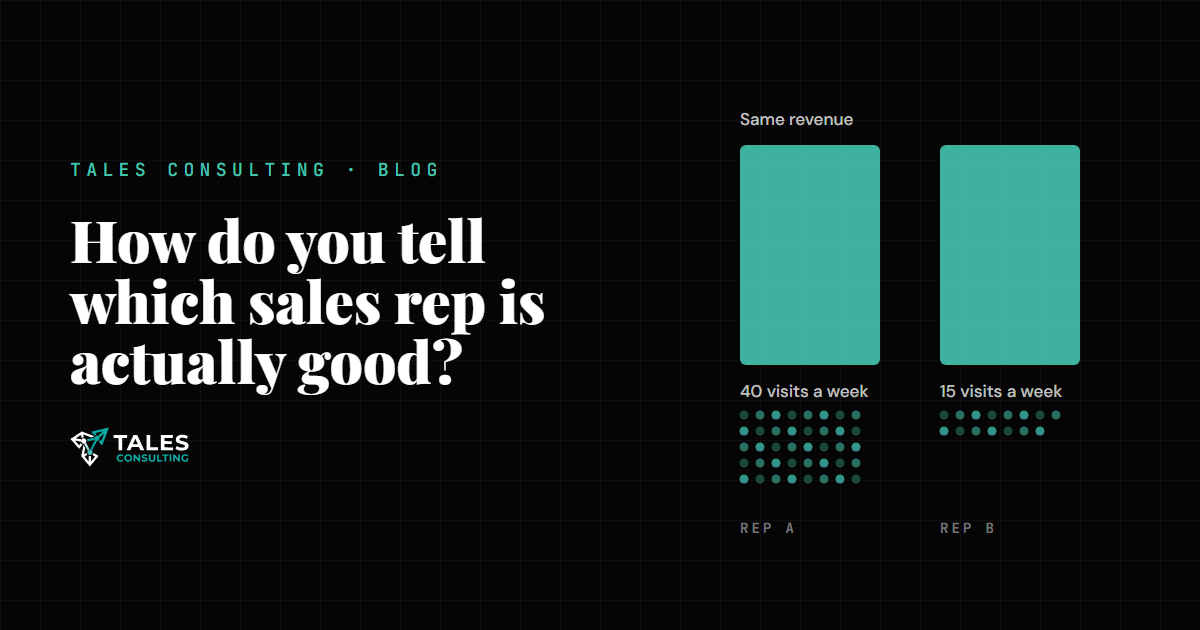
Two reps can bring in the same revenue in very different ways. One visits forty outlets a week, follows up every order within two days and keeps small customers buying. The other visits fifteen, spends most of the week with two large accounts and has a quiet month whenever either of them does.
On the sales report they look the same, though in your business they are very different. The first one is building something the rest of the team could learn from, while the second is carrying a risk you cannot see.
The figure also hides the reps who work hard and still fall short. Someone who visits as many outlets as your best people, but at the wrong hours or in the wrong order, needs a different plan. Someone who is barely visiting at all needs a different conversation. From the sales report alone they look like the same problem.
What to look at instead
A good rep shows up in what they do, week after week, as much as in what they sell. The questions worth asking are about behaviour:
- When do they start? In many trades the first visit of the day matters. Outlets that are visited before ten often order more than the ones visited after lunch, because the owner is there and the shelf has not been restocked by a competitor.
- How do they spread their time? Who do they visit, how often, and how long do they stay? Are they seeing the customers who could buy more, or the ones who are easiest to visit?
- Do they follow through? When a customer asks for something, how long before it is done?
- What happens after they leave? Does the outlet order again, and how soon?
None of this is new to a good sales manager. The trouble is that the answers sit in places nobody can read together: route sheets, WhatsApp messages, order books and the manager's memory. By the time someone has typed it into a spreadsheet, the month is over.
Recording the work, then reading it
The way round this is to have the work record itself. When each visit, order, payment and note is captured on the rep's phone as it happens, the questions above stop being guesswork. You can see who reaches their first outlet early, who spends their time where the money is, and what your best people do that the rest do not.
Reading that record is where the real work is. The pattern that matters is rarely in one number. It sits in the relationship between thousands of them: who visited where, when, for how long, what was ordered afterwards and what changed outside the business in the same weeks. That is the work we build software and AI to do.
Once you can see it, three things get easier:
- Coaching. You can tell a rep exactly what the best people do differently, with their own figures next to it.
- Performance reviews. The evidence is already there, so the conversation is about what each person actually did.
- Hiring and territories. You stop guessing which kind of person and which kind of route produces results in your business.
If you want to know what your own team's records would say, see what we build for field sales teams or bring us the questions you most want answered.